June and July Edition
STORYTELLERS: reading, writing, and encouraging
ST. GEORGE’S WRITERS
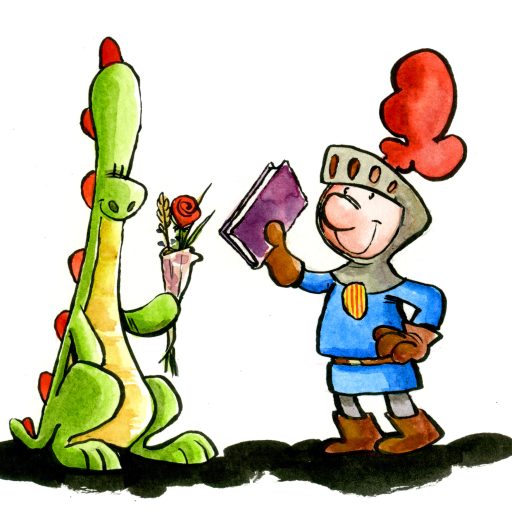

We’re been telling stories since long before we developed a writing system to record them for posterity. If you remember your Beowulf, you’ll recall that the old scops (pronounced “shops”) gathered everyone in the great halls in the evenings to hear of the deeds of their heroes. The mead the thanes passed around went well with the imagery of dragons guarding hordes of gold, knife fights in icy oceans, and the sound of crunching bones in battle.
But before the Angles, Saxons, and Jutes, Homer and Virgil entertained thousands as the equivalent of best-selling novelists of their times, even though both were likely illiterate. They didn’t need to read and write; they had their voices and bodies, their imaginations and memories. Stories are stories, no matter how we consume them.
Today the audio book is on equal footing with the printed word, whether digital or paper. What is non-negotiable is that the story must be told first. As Faulkner says, if a story is in you, it must come out. So the world is ours now, if only for a fleeting moment. We have the pen, and the mead bowl is ours.

“If there’s a book that you want to read, but it hasn’t been written yet, then you must write it.”
-Toni Morrison
William Shakespeare was born to tell stories. The son of a local, somewhat dishonest, politician, Shakespeare was most likely expected to become a glovemaker like his father, or a farmer, like his mother’s people. But he was remarkable. He had an almost perfect memory, from what scholars can deduce, giving him the ability to remember details about countries and cultures far removed from his own. He was an actor himself, a wordsmith, a humorist, a philosopher, a scholar of the Bible — all things that stitch together such depth in his works and leave us as devoted to them today as the Elizabethans were during their time.
D.H. Lawrence, Edgar Allan Poe, Nathaniel Hawthorne, George Eliot, Mary Shelley, E.M. Forster, Oscar Wilde, Jane Austen, Charlotte Bronte, Edith Wharton, F. Scott Fitzgerald, Flannery O’Connor, Eudora Welty, Zora Neale Hurston, James Baldwin, Truman Capote, Harper Lee, Langston Hughes, Alice Walker, Thomas Pynchon, Amy Tan, Margaret Atwood, Toni Morrison, Louise Erdrich, Cormac McCarthy, James McBride, Zadie Smith. The list is endless.
 St. George's Writers